Saturday, 24 March 2012

The Weekend

Friday saw Robin & I hammering it up to the Fujairah National Dairy Farm. We arrive bang on time, at dawn. It is grey and overcast, not much stirs. A lone female Hen Harrier, sits hunched in the field. A Eurasian Sparrowhawk passes by. But not much else, just a scattering of the usual migrants. An early Blue-cheeked Bee-eater glides overhead. Along the roadside are 60+ Pale Rockfinch and Steppe Grey & Woodchat Shrikes.

The farm, a vagrant trap
between the mountains & the coast.
Pale Rockfinch.
We enter the farm proper and meet up with Andrew Tywman. We split up and the search for migrants begins. 3 Blyth's Pipits, 2 Richards Pipits and a Siberian Stonechat being the best. Then I spot a summer plumage Sociable Plover which livens up proceedings a little. We cross the road & enter the Goat Farm, 85 Greater Short-toed Larks circle us. A distant Wryneck perches on top of a bush. A fine White-spotted Bluethroat perches for all to see. But that is about it.

It is now time to leave and drive to Khor al Beidhae for the high tide. We arrive and the birds are close. 305 Bar-tailed Godwits and 5 Great Knots being the highlights. A summer plumage Little Tern is an early migrant & a Lesser Short-toed Lark flies by. We drive home, a little disappointed from the day.

2 species added (total 244 species): 540 kms travelled.

The next day I was guiding Manfred & Annamarie Gotz in Al Ain. It was a pleasant day out, with the usual suspects on view. Strangely, there were hardly any migrants to be seen.

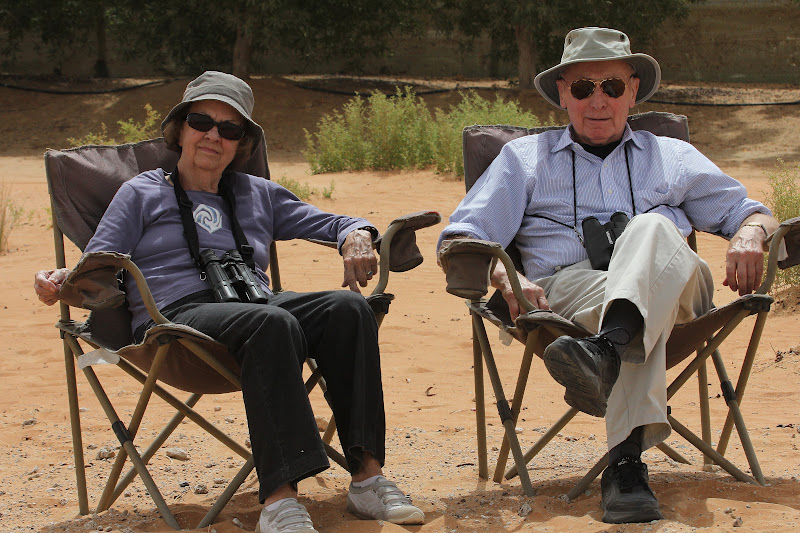
Annamarie & Manfred enjoying the sunshine.

The imposing Jebel Hafeet.

The road to the top of the mountain.

Zakher Pools.

Blue Rock Thrush in the garden
 of the Mecure Hotel.

A very high Barbary Falcon flew overhead, the odd Egyptian Vulture flew by. Arabian Partridge and lots of Chukars were feeding on the grass. The Environmental Agency has introduced these birds here and they are everywhere!


One of the many introduced Chukars.

1 species added (245 total): 340kms travelled. 

The Wheatear Bonanza!


It is Thursday morning and I am in Robin’s office. We are chatting about Khalifa’s great find, of a male Finch’s Wheatear at Jebel Dhanna, the first for many years. We had planned to go birding locally on the island, but what if we could get to JD this afternoon? It is a long way, but we decided to risk it.

It is 3.30 pm & I am all revved up & Robin arrives. The first bit of road is slow, but then we eat up the miles. Khalifa is there waiting for us. After a couple of anxious minutes, we spot the bird, sat atop the perimeter fence. For the next few minutes we enjoy good views of it flitting around. I stomp around the field looking for other migrants while Khalifa & Robin report the bird flew onto nearby rocks. It must have gone to roost early, as it was never seen again!

A fine male Finch's Wheatear

 Photos courtesy of Khalifa.

A fine male Lesser Kestrel surveys the grass from his lofty perch. 50+ Eurasian Skylarks + Pied, Red-tailed, Black-eared, Northern and Isabelline Wheatears are the other migrants present.
It is getting dark & I am anxious to return home, as Carol had just finished work & was now on holiday for the next two weeks. She has plans! Khalifa drives ahead, to attend to formalities at the gate. It is now quite dark; I put my binoculars away, in readiness for the long drive home. Then Robin asks innocently, what is that bird on the rock over there? I ask for his binoculars, I fumble with the focussing, and then I see it! A male Kurdistan Wheatear! I jump out of the car, wave frantically to Khalifa but he is now on the open highway! A rapid phone call & he turns around, but as all rare things do, it had vanished! The search begins & looked hopeless, as it is now really dark. Khalifa spots something in the trees & it is the bird. Camera’s click & we put out the news. We smile all the way home!
A male Kurdistan Wheatear. Nice!
Photo courtesy of Khalifa.
I really can’t believe our good fortune. We go for one rare bird and come away with two. I am now ready for the weekend!

3 species added (total 242 species): 490kms travelled.


Monday, 12 March 2012

The Ides of March

The Ides of March is strictly speaking, the middle of the month but here, I use it in a slighlty broader sense. The middle of March is typically a time, when new migrants are flooding in, on their way to get to their northern breeding grounds. Birds appear & disappear fast, few staying for longer than a day. It can prove a trying time for the year lister, as you often have to be in more than one place at once, with migrants being scattered over a wide area. There are some uncommon but key species to record, which are often easier to see in spring, than any other time of year. So, it is a busy time for all. This is how I got on.
The natural desert, south-west of Madinat Zayed.

Sunday saw me in the central desert, looking into a sandstorm! A retreat into the green areas of Madinat Zayed produced a few migrants: Hoopoes; Woodchat & Turkestan Shrikes, 2 Tree Pipits, various species of wheatears etc.
Hoopoe, with an ant!

Woodchat Shrike

Turkestan Shrikes are pouring north,
in good numbers at the moment.

After work, I visited Sadiyat Island Golf Course looking for the Cinereous Bunting but without success. By now it was a roaring gale and both myself and the migrants were struggling against the strong wind. A good selction of species were again recorded, best being 60 Pale Rockfinch.
As a side show, I saw two new birds for my garden list here in Mohammed Bin Zayed City. When I arrived home, both Black-eared & Northern Wheatear were sat, side by side on my wall.

0 species added (238 total): 520 kms travelled.

I managed to get a couple of hours birding around Mushrif Palace Gardens on Monday afternoon.  It was excellent, with a wide variety of migrants recorded:
Crested Honey Buzzard; Wryneck; Masked Shrike; Caspian Stonechat; 2 Orphean Warblers; Lesser Whitethroat; 9 Menetries Warblers and new for the year, Blackcap.

1 species added (239 total): 340 kms travelled.

Tuesday afternoon after work, was a quick trip to the Emirates Palace Hotel. Searching for migrants in the company of Oscar & Robin. It was still very windy, with a lot of dust in the air, which made visibilty quite poor at first. But then the wind stopped blowing & it was suddenly quite hot & very pleasant, walking around the grounds. Good numbers of migrants included 5 Steppe Grey Shrikes; 5 Woodchat Shrikes; 12 Turkestan & 4 Daurian Shrikes; a Rufous-tailed Rockthrush; amazingly 5 Back-eared Wheatears; 2 Pale Rockfinches and pride of place, went to an adult Rose-coloured Starling cavourting on the lawn.

A female Rufous-tailed Rockthrush.
Pale Rockfinch, a nomadic species,
 which visits us in varying numbers
 every spring and sometimes in the fall.
Rose-coloured Starling was a welcome surprise.

0 species added (239 total): 80 kms travelled.

Saturday saw me travelling to Lulu Island in search of Grey Hypocolius. We were not to be disappointed, with several flocks totalling at least 85+ birds. The flocks were flighty, but eventually everyone got good views down the telescope. 4 Blue Rock Thrush & a Rufous-tailed Rock Thrush were the other highlights.

A fine male Rufous-tailed Rock Thrush.

In the afternoon a quick trip to the Emirates Palace Hotel revealed 3 Rufous-tailed Rock Thrush; a Blue Rock Thrush; 4 Black-eared Wheatears & 6 Woodchat Shrike. Nice birding but nothing new for my year list.

0 species added (239 total): 80 kms travelled.

Monday saw me birding Mushrif Palace Gardens, the AD Racecourse & the Officer's Club. Migrants were much fewer in number, than in the previous week, but several quality species were seen well: 2 Crested Honey Buzzards; 2 Masked Shrikes and a superb adult male Peregrine were the highlights.

0 species added (239 total): 80 kms travelled.

The soothsayer speaking to Caesar, beware the Ides of March. Is equally applicable to the year lister!

Saturday, 3 March 2012

Fluctuating fortunes!

It is now March, and migrants are flooding in. But before I can to grips with all these new arrivals, there is some old business to be completed. While I was away, two absolute mega-rarities were found: Black-naped Oriole & Ashy Drongo. The former species is a new record for the UAE!

Friday, saw myself, Robin & Hazim driving north at dawn, first to scabland & then on to Safa Park. The small pool unfortunately, held no Red-crested Pochards this morning. We arrived at Safa Park & it was packed with people, already. We scoured the wood for the oriole, but with no success. So we walked across to try for the Hume's leaf-warbler. I briefly saw it & also heard it, but the others dipped. Mark, then joined us & we saw it briefly, to everyone's satisfaction. It was time to move on.

A quick inspection of the Dubai Pivot Fields produced a Pale Martin, Turkestan Shrike & the calcarata race of Citrine Wagtail (another first for the UAE)!

The day heated up & a stop in the desert produced nothing of interest. Ain al Faydah appeared on the surface to be very quiet indeed. Two adult Crested Honey Buzzards were flushed from thier mid-day slumber and then Robin pulled the bird out of his hat! Slight movement turned into cold hard certainty & we all obtained great views of the Ashy Drongo fly-catching. Nice one Robin!

Ashy Drongo.
Arabian Partridge has been introduced into this area,
 & seems to be thriving.
A quick look over Zakker Pools produced the 4 Greater Whitefronted Geese, but nothing new. We returned home happy, with a nice day out.

4 species added (227 total) 500 kms travelled.

Saturday dawned, with Carol talking to Graham of ticker fame. I was in bed, but before Carol could finish the sentence containing Greater Stone Plover, I was on my feet, running around in circles! Clothes, bins & scope & I was gone, only just remembering to open the garage doors! Twenty five minutes later, I was smiling, looking at the bird standing quite close. A first for the UAE in the bag!
Graham & Mark had arrived at dawn, played a tape & it materialised out of the fog! Congratulations boys!

The heroes- Mr & Mr Smug!
Oscar (who never twitches of course) arrived, as did Mr Lulu and eventually Simon. Mr Lulu decided on a last minute sprint, which was quite entertaining, if not graceful!

Greater Stone Plover- honest!

My digi-scoping effort!

The best I could do!

The Happy Gang, this is their best side!

A fine male, Pied Wheatear, was a year tick. A big thank you to Mr & Mr Smug!

2 species added (229 total): 60kms travelled.

A Saturday afternoon jaunt to the Emirates Palace Hotel, with Andrew and Oscar, was slightly marred, by the rising storm: strong winds & blowing dust, didn't help the birding. However, I spotted 2 Buff-bellied Pipits among the Water Pipit crowd; strangely, both in full winter plumage, where as all the Water Pipits were coming strongly into summer plumage. Perhaps, this is indicative, of the varying distance these birds have to migrate?
A Hume's Leaf-warbler called and we eventually obtained fleeting views, among the strongly swaying trees. A nice male Caspian Stonechat provided great views, despite the increasingly bad weather. The best of the rest, was a fine Steppe Grey Shrike.
With ever increasing darkening skies, I high-tailed it home.

0 species added (229 total): 80kms travelled.

A Tuesday afternoon walk around Abu Dhabi Island, with Oscar & Robin was very productive. Combined total of migrants for MPG's; Racecourse & the Officier's Club was quite impressive in both species & numbers:
1 Gr. White-fronted Goose; 1 Crested Honey Buzzard; 9 Daurian Shrike; 3 Steppe Grey Shrike; 1 Masked Shrike; 5 Woodchat Shrike; 1 Red-rumped Swallow; 1 Common House Martin; 1 samamiscus Common Redstart; 3 Eastern Black Redstart; 2 Caspian Stonechat + 1 female variegatus/armenicus; 9 Northern Wheatear; 16 Pied Wheatear; 1 Eastern Black-eared Wheatear; 11 Isabelline Wheatear; 1 Song Thrush; 8 Tawny Pipit & 4 Water Pipit (new year birds,in bold).

4 species added (233 total): 75 kms travelled.

The British Embassy has issued its high risk of terrorism threat here in Abu Dhabi. The next level of notification is evacuation. But have no fear good people. In their wisdom, the authorities have ordered a fleet of ships to be on standby (just in case). The good news is that they will be captained by Italian Captains, who in the true tradition of Italian naval tradition, have none of this women & children first nonsense! This is very good news for us birders, as we can just push the women & children into the sea, if necessary. Thereby, having the opportunity of increasing our lists in the future.

A view across a small part of Al Wathba Lake.

Wednesday afternoon saw me birding around Al Wathba Lake. The flock of Greater Flamingoes was as impressive as ever; c1,600 birds and around seventy active nests. 7 Marsh Harriers, a Pallid Harrier and a Eurasian Sparrowhawk cruised over head, causing a bit of anxiety in the flamingo flocks, who honked their disapproval, everytime a bird of prey circled overhead. The Eurasian Golden Plover was still on its favourite bit of sand, in the middle of the lake. A cracking full summer plumage Rose-coloured Starling flew by and that was about it! Not one hirundine came in to roost - nothing!

0 species added (233 total): 70 kms travelled.

On Thursday evening Carol & I drove up to Dubai to attend Simon's 40th birthday bash. A very nice time was had by all. Good to meet his Mum & Dad, see the video his brother made (he!he!he!) and well done to Grace for organising things so well.
Friday morning was shopping hell in the mall. I sat with other men, outside of the ladies fitting room (how inappropriate is that? Because those expensive things they all try on, never really fit, do they)? These men all had various things in common, sad, defeated eyes, looking at nothing in particular, until a lady appears & approaches them. Briefly their eyes shine and they nod and smile, in the vain hope that she will pick one and then escape becomes a possibility. However, they normally go back in to this void, before re-emerging again about 20 minutes later and the same scenario unfolds. One strange aspect of this ritual, is that all the men clutch handbags, mine was a very nice dove grey colour. You don't see this too often in life, at least not in the cirlces I mix in! A more pleasant aspect was meeting Nora for lunch. Great to see her again & on good form too! Khalifa called with the news of a Cinereous Bunting, so a detour to the Saadiyat Island Beach Golf Course was made.
4 Grey Wagtails were seen
Plenty of White Wagtails were on their way north.

A fine male Rufous-tailed Rock Thrush.
Isabelline Wheatears were numerous.


Some beautiful male
 Northern Wheatears were seen

Tawny Pipits were numerous.

No bunting, but a good variety & number of migrants. Nothing rare, or uncommon but both Pale Rockfinch & Rufous-tailed Rock Thrush were new for my year list.

2 species added (235 total): 350kms travelled over two days.

It is Saturday and it is The Road to Hell, which means Sila of course. I have teamed up with Mark & Oscar, which is great, because this means I am not driving! We arrive at our destination just after dawn and it is cold! It is always cold at Sila!
I walk around the large plantation, the others drive. We meet & explore the two small garden areas. Migrants are quite prolific, nothing rare, but lots of variety. The marsh area was slighly quieter but still prolific and the park was nothing short of manic!

Over 125+ Hoopoes; 20+ Steppe Grey Shrikes; 25 + Turkestan Shrikes; 4 Daurian; 15+ Woodchat & a Masked Shrike. Pied & Isabelline Wheatears were common, with a few Desert Wheatears. A highlight were at least 6 Caspian Stonechats + a further four others of siberian origin.
Hoopoes were everywhere!
Turkestan Shrikes had arrived in large numbers.

A confiding Isabelline Wheatear. 
The highlight of birding the park was a superb Grasshopper Warbler.

You don't often get views like this!


Bird of the day.


A quick stop at the various locations in Mirfa were equally productive, lots of migrants, wheatears & shrikes with a Common Quail & 4 Pale Rockfinch being the highlights.

A big thanks to Mark, who did all the driving! Sometimes, it is just so nice to sit back and be driven around!
3species added (238 total): 750kms travelled.

Monday, 27 February 2012

Rwanda: Akagera National Park.

Several decades ago, John Gooders wrote a book, on birding around the world. By today's standards, it wasn't a very good book, but I owned a copy and kept dipping into it, at every opportunity. Oh, to visit those magical, far flung places, just dripping in new birds. All of them waiting, just for me! There are certain birds with an iconic status, one of them being the Shoebill. This species is bizarre! It is five feet tall, slate blue, quite fat, with a bill that looks well, just like a shoe! I wanted, no needed, to see this species very badly! But it is rare, found in isolated and vast swamps, scattered over the remotest parts of Africa. A little bit tricky then! But, one of the places to see this bird, was here in Rwanda, not too far from the capital city of Kilgali - the Akagera National Park!

This park was established in 1934 and covers an area of swamp, bush and savanna habitats, that are found alongside the Akagera river. The place is huge, around 1,200 square kilometers - it is the largest area of swampland in central Africa. But it has been badly neglected. Poaching through the years, has taken its toll and the various armed groups that have rampaged through the country, in past decades, haven't helped either. I didn't know what to expect!

The rather modest entrance, to this national park.
We entered the park and slowly its delights unfolded around us. Vast lakes, surrounded by papyrus swamps, magnificent mountains, clothed in bush, isolated patches of woodland and beautiful grasslands. Best of all though, was the almost complete lack of other tourists - it was all ours to explore at will. And explore we did, on little winding, muddy trails, that criss-crossed the mosaic of habitats to be found here. This was wilderness Africa at its very best. I was in my element.

The southern sector of the park -looking east.

As you travel northwards,
the habitat gets more & more open.
As we proceeded, every so slowly northwards, the scenery got even better and the game sightings increased. It was a great day, with abundant birds and some nice mammals, including a loan Roan Antelope,  on a distant hillside. The bird log that evening as a long one and we all slept well, not knowing what the morning would bring.
Getting around in Akagera.
Remote, wonderful, savannas.

Topi's are common in the grasslands.
A fine male, Topi.
Defassa Waterbuck
Massai Giraffe -
a bit different from what I am used to!

Errm!
 African Hawk Eagle.

Striped Kingfisher

Grey-backed Fiscal Shrike
The next day, was our last day birding. It was a shortened day, from dawn until around 2pm, as we had to drive back to the capital. This day we entered from the north and explored a tiny portion of the park. And what an inspired choice it turned out to be! Birds competed for our attention with the abundant mammals. Shutters on our cameras clicked rapidly. As we bounced around, on the back of our vehicle, every corner revealed new sightings. For me, it was the best day of the trip - it was just awesome!

Red-necked Francolin
Black-headed Gonalek.

Red-faced Barbet
Photo courtesy of Oscar Campbell.
Lesser Striped Swallow
African Moustached Warbler -
normally, secretive & difficult to see.
Photo courtesy of Oscar Campbell.

Spotted-backed Weaver - nest building.
A distant Shoebill - has to be bird of the trip!
Photo courtesy of Oscar Campbell.

Oscar then decided that the show needed a new star, and he found a distant Shoebill stood atop a raised mound, at the edge of the swamp! Both Oscar and I had seen Shoebill before in Uganda (on different trips) but we needed no extra invitation to enjoy this one as well! Graham and Mark, just beamed!

Our short trip, netted us over 300 species of birds and over 20 species of mammal. But, my abiding memory, will be of the two fabulous places that we visited: the wonderful montane forests of the east and the splendid scenery and wildlife of Akagera. I will be back - there is unfinished business here, a small matter of a few Gorillas to see!

Graham & I shared a room throughout this trip (as did Oscar & Mark). We stayed at one particular hotel for two nights. On the second night, I went into the bathroom & discovered a huge carton of vaseline, that hadn't been there the day before! Thoughtful or what? Maybe just a little too thoughtful?

Thanks guys for been such good fun and great company. Till the next time!

Mammal List:

Olive Baboon (Papio cynocephalus anubis)

Several troops seen in and around Nyungwe Forest & in Akagera National Park.

Grey-cheeked Mangabey (Cercocebus albigenia)

At least 8 seen along the roadside in Nyungwe National Park.

Black-faced Vervet (Green) Monkey (Cercopithecus aethiops)

A troop was always present in the Forest Lodge guest House at Nyungwe. Also small numbers seen in Akergera National Park.

Samango Monkey (Cercopithecus mitis)

Small gropus seen every day in Nyungwe Forest.

Please note, this species is known by a variety of names, including Blue & Syke’s Monkey.

L’Hoest’s Guenon (Cercopithecus l’hoesti)

Seen every day in Nyungwe Forest, sometimes in large groups. The commonest primate at this location.

Guereza (Abyssinian ) Black & White Colobus Monkey (Colobus guereza)

A large troop of between 20-25 individuals, seen by the side of the road in Nyungwe Forest.

Chimpanzee (Pan troglodytes)

Groups were heard on two different days in Nyungwe Forest. Nests were also seen.

Plains (Burchell’s) Zebra (Equus burchelli)

Up to 70 animals a day seen in the northern part of Akagera National Park.

Warthog (Phacochoerus africanus)

Seen in good numbers (up to 30 animals each day) in Akagera National Park.

Bushpig (Potamochoerus larvatus)

Signs of this species, were noted every day, on the trails in Nyungwe National Park. No animals were actually seen.

Hippopotamus (Hippopotamus amphibus)

A group of six, seen in Akagera National Park.

Maasai Giraffe (Giraffa camelopardalis tippelskirchi)

Up to 25 seen in a day, in the norther section of Akagera National Park.

Buffalo (Syncerus caffer)

A large herd of over 100 animals and several smaller groups, seen in the northern section of Akagera National Park.

Bushbuck (Tragelaphus scriptus)

At least five noted, in the northern section of Akagera National Park.

Roan Antelope (Hippotragus equinus)

A lone animal, seen in the northern section of Akagera National Park.

Defassa Waterbuck (Kobus ellipsiprymnus defassa)

Up to 30 seen each day, in Akagera National Park.

Bohor Reedbuck (Reduncta redunca)

Seven seen, in the northern section of Akagera National Park.

Topi (Damaliscus lunatus jimela)

Over 200 a day, seen in the northern section of Akagera National Park. This is a significant population of this rare and scattered subspecies.

Impala (Aepyceros melampus)

Rather surprisingly, only small herds seen of this common and widespread species, in Akagera National Park.

Oribi (Ourebia ourebi)

One seen in Akagera National Park.

Golden (Common) Jackal (Canis aureus)

One seen at dawn, crossing the road, outside of Akagera National Park.

Dwarf Mongoose (Helogale parvula)

One seen in Akagera National Park. This species lives communaly and makes its home in termite mounds.

Aardvark (Orycteropus afer)

Aardvark holes were commonly seen in Akagera National Park.

Carruther’s Mountain Squirrel (Funisciurus carruthersi)

Up to ten animals a day, seen in Nyungwe National Park.

Boehm’s Squirrel (Paraxerus alexandri)

Common in Nyungwe National Park.

Ruwenzori Sun Squirrel (Heliosciurus ruwenzori)

Up to eight animals a day, seen in Nyungwe National Park.

       
Photos courtesy of Oscar Campbell.

As we were leaving to go to the airport, this minibus was in front of us. It is always nice to give the last word to the locals!