Monday, 31 May 2021

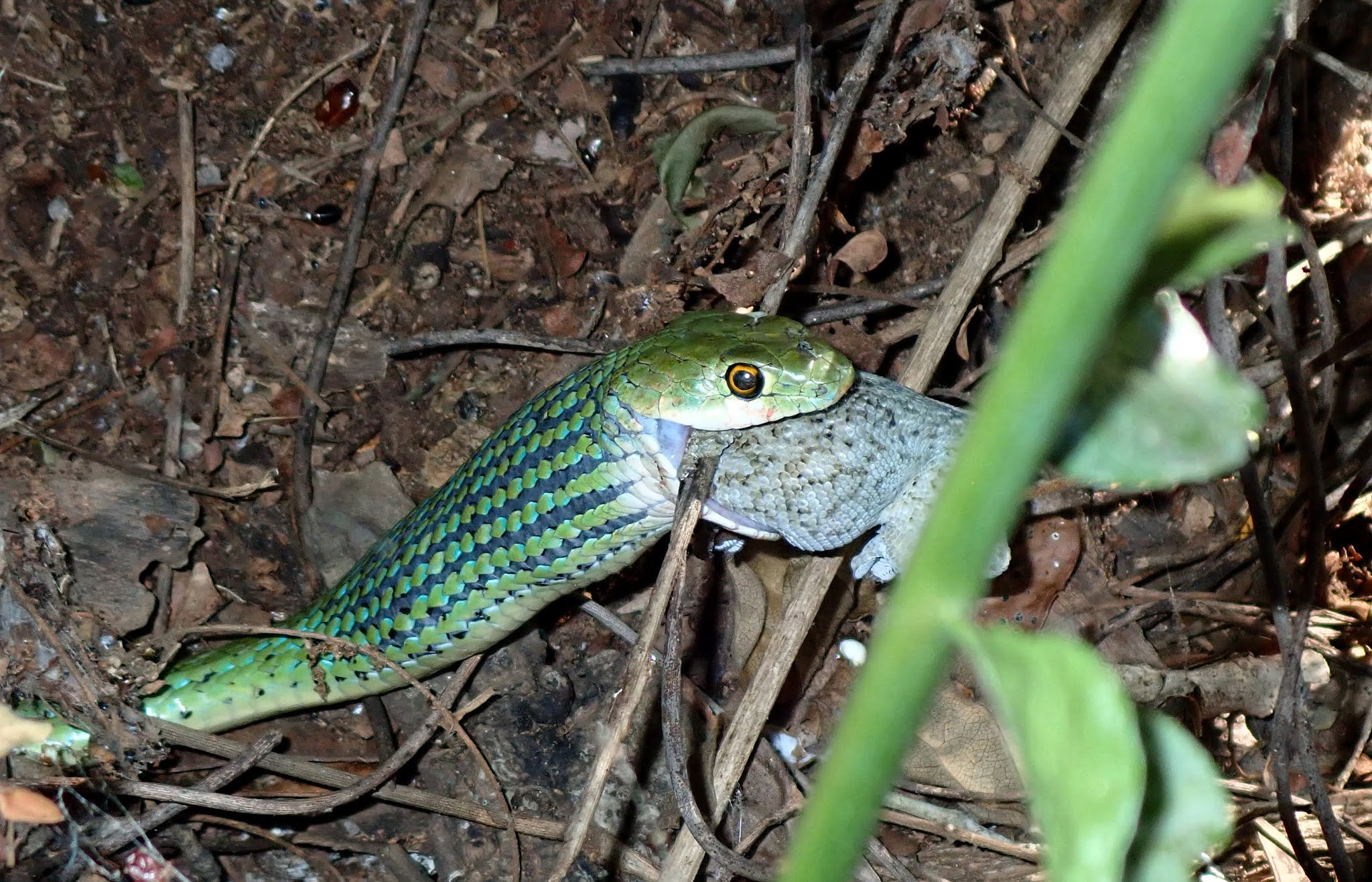
Many Spotted Snake: Photo Essay

Many spotted Snake
(Amplorhinus multimaculatus)


Delana & I were sat in camp at Ndumu, enjoying some downtime, when we heard a loud plop of something soft, hitting the ground. The sound came from a tree about 30 m away from us. We both went to investigate & were amazed by what we found! There was quite a large green snake devouring a Chameleon, which was still alive & struggling. The snake must have ambushed its prey on a branch much higher up & when it struck & caught it both tumbled to the ground.

A sighting such as this is a rare event indeed!

The Chameleon was struggling valiantly, 
but to no avail.

Sometimes the Chameleon would pop out again,
 as the snake struggled to get a firmer grip.

The snake would periodically rise itself up 
off the ground, in order for its prey to be
 swallowed more easily.


But what kind of snake was it? Both of us had never seen anything looking like this snake before. A quick look in the field guide produced the answer. A Many Spotted Snake sometimes known as the Many Spotted Reed Snake. It is found in the eastern part of South Africa & eastern Zimbabwe. There is a separate population in the Cape region. It is a slow moving diurnal snake preying on frogs, small rodents & even Chameleons! It is mildly poisonous & quick to strike when threatened, but its poison is not harmful to humans.

Down the hatch!


This snake comes in two basic color forms: dark grey to black or the bright green version, which this individual was. It is often found in wetlands hence the alternative name of reed snake, but has wide habitat tolerance including fynbos vegetation of the Cape floral region. It was amazing to witness such an event & the way it dislocated its jaw, to swallow the prey whole, was particularly impressive! Tough for the Chameleon though!


Ndumu Game Reserve

We left Mkhuzie on 11th May for the relatively short drive to Ndumo Game Reserve, which is right up close to the Mozambique border. It is a famous location for birders, as it has a good cross section of habitats & it is in an enviable position. This was a new area for me, one I had been wanting to visit for a while now, so I was excited to finally arrive here!

The camp site was very pleasant & yet again 
we had it all to ourselves!

Our camp kitchen.

Our brilliant tent!


The beautiful Usutu River

Cheers!

Giraffe

They were quite common in this reserve.


We set up camp, then drove to the Red Cliffs Picnic Site in the far west of the park. it was wonderful light in the afternoon & we had a lovely time but without seeing anything special.

Nyamithi Pan

One of the finest spots for birding in the country!

Only good for morning viewing.


Delana in the hide.

There is a huge mixed breeding colony here, 
but difficult to get good photos 
because of the bad light.

Pink backed Pelicans

Great to see these birds close.

First time I have seen this species at a colony.

Juvenile Black crowned Night Heron


On the 12th May & 15th May we drove the short distance to Nyamithi Pan & what a spectacular spot it was! The scenery & birding were superb & we both enjoyed our time here tremendously.

This pan is a haven for water birds.

Morning viewing is terrific here.


Great White Pelican

An uncommon species here.


Pink backed Pelican


Great to see so many of them & so close!


Yellow billed Stork


Great White Egret

Open-billed Stork


Spur winged Goose

Immature African Fish Eagle

African Pied Wagtail

Lesser Swamp Warbler

African Reed Warbler

Unusual to get such a good view of this species.

The guide in the background
 is armed!

Female Pink throated Twinspot

There were three birds in scrub on the forest edge.

Only this individual gave reasonable views.

The male kept well hidden!


I hadn't seen this species for a long time.

Neergaard's Sunbird

Stunning male.

African Broadbill

After a long search we obtained stunning
 views of a pair.


Brilliant birds!


On 13th May we went on an organized bird walk with the resident bird guide in the near by sand forest. Birds were not plentiful but we saw some range restricted & hard to see species. It turned out to be a terrific mornings birding.

A poor photo of a Rudd's Apalis

Found in scrub on the edge of the forest.

Square tailed Drongo

A common but secretive species in the forest.

White eared Barbet

Come closer & look at this.....

Possibly the worst photo ever of a 
Pel's Fishing Owl!

The next morning saw us walking in the forest along the Pogola River. True forest is being encroached by subsistence farmers & the park authorities seem powerless to act. However we enjoyed an excellent mornings birding, racking up quite a few difficult & hard to see species.

The distant pans are where the real action is!


Why of course!

On the afternoon of 14th May we climbed the lookout tower for a view of the reserve. The light wasn't great but it gave you a good idea of the lay of the land. The next day we enjoyed another morning at the pan & then we reluctantly left the reserve on 16th May.