SATA (Azores Airline) proved to be an excellent way
of travelling.
The 15th May was basically a travel day: island hopping across the Azores & then flying to Lisbon, where Graham was waiting for us. Hadn't seen him for a while & it was great to see him again. He quickly navigated the Lisbon traffic to his villa in Cascais. We settled in & then went to a local restaurant for a nice meal & lots to catch up on.
Our beautiful two bedroomed house:
our home for the next three nights.
The view!
We saw Spanish Imperial Eagle from here!
I had previously sent Graham a wish list of the birds we wanted to see, so the next morning we were off for three nights away, further south than Lisbon. Graham had booked a two bedroomed house for us & we were off! Our center for our explorations was the small town of Castro Verde, about 200kms south of Lisbon.
White Storks were common on the journey south.
Common House Martin
This species proved to be very common
throughout this area.
Endless undulating plains.
Myself & Graham
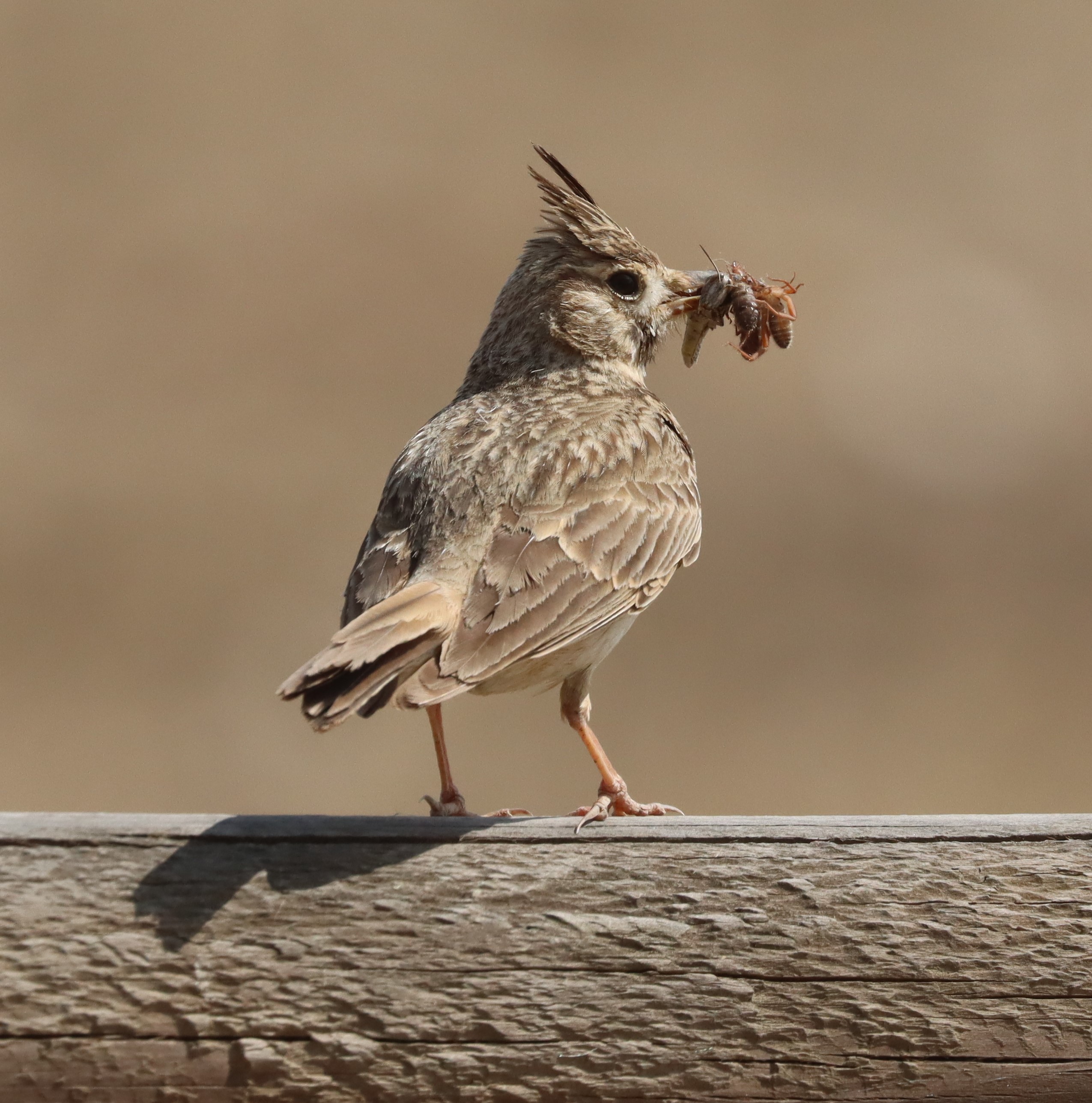
Thekla Lark
An abundant species in this area.
Displaying high above the grasslands.
This area contains the largest expanse of uncultivated plains in southern Portugal. It is an impressive steppe-like area, where cultivated fields are interspersed with large uncultivated areas. It is the best area to see both Great & Little Bustards, as well as my most wanted species Spanish Imperial Eagle & Iberian Green Woodpecker.
White Stork, abundant in this area.
We visited the local Bustard reserve in the late afternoon & we walked over quite a large area of plains. It was very dry but we saw a few birds:
Red-legged Partridge
Male Montague's Harrier
Little Owl
Red-legged Partridge; Short-toed Eagle; Montague's Harrier; Little Owl; 25+ Lesser Kestrel; European Roller; European Bee-eater & Hoopoe; Calandra, Thekla, Crested Larks & Spotless Starling.
Great Bustard, always very distant.
Up early on 17th May again looking for both Great & Little Bustards. This time after extensive searching, we found both species, although at some distance. We did enjoy good scope views & both species were new birds for Delana & species that I hadn't seen for many years. We also saw a pair of Black-bellied Sandgrouse, but yet again too far away for any decent photos.
We spent a couple of hours birding this area
of low scrubby hills.
Our next port of call was an area of scrubby hillsides close to the village of Penilhos. We found both Iberian & Woodchat Shrikes, plus a healthy population of Dartford Warblers. Yet another species that I hadn't seen for a very long time. Iberian (Azure-winged) Magpies were also in evidence.
Western Black-eared Wheatear
Just down the road at an old mining area, we found this handsome Western Black-eared Wheatear.
Our last stop was a riverine area with both Little Ringed Plover & Western Rufous Bush Chat. It was quite a pretty stop & we enjoyed our time here.
Cetti's Warbler
Eurasian Eagle Owl
Iberian Green Woodpecker
Long-tailed Tit
Spanish Imperial Eagle
Early morning of the 18th May saw Graham & I birding the Ribeira de Oeiras Area. (Delana had to stay home to do work on her project in South Africa). It was a beautiful morning & we walked along a ridge & then down into the river valley below. Cetti's Warblers sang from the riverine thickets & we flushed a Eurasian Eagle Owl, which obligingly perched in the open, before continuing down the river valley. The main reason for visiting this location was to find Iberian Green Woodpecker & we saw a pair. However, they were always distant & into the sun. On the way back to the car we saw 28 Eurasian Griffin Vultures spiraling above us. The finale was a superb Spanish Imperial Eagle flying overhead. We enjoyed an excellent couple of hours here & what a morning it was!
Short-toed Eagle
On the way back to pick up Delana we spotted a fine Short-toed Eagle next to the road.
Mertola is surrounded by nice countryside.
In the afternoon we spent a bit of time in the historic town of Mertola before birding at Agua Santa da Morena, which is a river valley with some tall trees.
Iberian Magpie
We were largely confined to birding along the road here. Best birds were a pair of Rock Buntings along the road & both Red-rumped Swallow & Eurasian Crag Martin breeding under the bridge.
In the evening we went searching for Eurasian Scops Owl. We quickly heard two birds calling but it took us over an hour & a lot of walking in the dark, to finally get one perched in the torch beam.
The farm dam was very birdy.
19th May was our last day in this area. We decided to bird the farm where we were staying & this proved to be an excellent decision. We wandered around the fields & a nearby dam which was full of waterbirds. Freshwater is scarce in these parts so waterbirds don't have a lot of choice.
Best birds : Red-crested Pochard; Ferruginous Duck; Gadwall; Great-crested Grebe; Glossy Ibis; Eurasian Spoonbill; Black Kite & Spanish Sparrow.
Greater Flamingo
Eurasian Spoonbill
Dunlin & Common Ringed Plovers.
Then we packed & after a late breakfast drove towards Lisbon. Our next stop was at a small reserve on the Sado estuary called Mourisca Reserve. It was a nice little place with a mixture of habitats from the estuary itself to salt pans & just inland a small patch of woodland.
Red-crested Pochard
Our last stop was right on the edge of Lisbon itself: Estacao de Santa Iria, a tiny reserve on the Tagus Estuary surrounded by houses & roads. It was a very birdy place though with plenty of waders & both Booted Eagle & Common Buzzard overhead.
We stayed in Graham's home all day on 20th May, catching up with laundry & my blog. It was a pleasant day. Graham has gone on a previously arranged pelagic trip. Hope he does well.
We set out early on 21st May for the reserve on the nearby estuary. However, before one can reach the reserve one has to negotiate nine kilometers of private roads. Luckily for us, the gate opened & we were in! This is a huge rice growing area, it is rice growing on an industrial scale & the many fields are constantly changing, as the rice is grown & harvested. We drove slowly down the network of roads seeing quite a few species.
Glossy Ibis
One of the commonest birds were the huge flocks of Glossy Ibis, probably over 200+ birds. A few Lesser Black backed Gulls were dotted about, as well as Western Marsh Harrier & Black-winged Kite.
Birding from inside the café.
We arrived at the reserve entrance just as it was opening & what a delight it was. There was an excellent café overlooking a productive marsh & area of open water. More than 100 Collared Pratincoles were flying around. Graham got excited when a Whiskered Tern flew in, a new species for his fast growing Portuguese bird list!
The view from the hide.
Eurasian Spoonbill
Pied Avocet
Ruff with Black-winged Stilts
Black-winged Stilt
One of the many chicks on the reserve.
Booted Eagle
Western (Blue-headed) Wagtail
After an excellent breakfast it was time to walk around the reserve & bird from some of the many hides. 12 Common Shelduck were a good local record & Northern Pintail, Eurasian Teal & a Gadwall were in among the numerous Mallards. A few Western Swamphens lurked in the reeds, with one bird sat on a nest.
However, it was the flocks of waders we were interested in. There was a large flock of Black-tailed Godwits & we searched through them diligently for the long staying Long-billed Dowitcher which had been seen the day before. It took us many hours to find it & Graham was the one to pick it out in the scope. A full summer plumage Long-billed Dowitcher in the scope in Portugal! Not bad! But things were about to get even better! When it was Delana's turn to look down the scope, she said she saw two birds together, both in summer plumage! Both Graham & I confirmed her sighting, this was incredible! Definitely the highlight of the day. We also saw a full summer plumage Spotted Redshank & two late Greenshanks. Two Little Bitterns were a good record for the reserve, but both proved camera shy. Eurasian Spoonbills were in good numbers & all the birds kept getting flushed by a succession of Booted Eagles & Western Marsh Harriers.
We then drove back into the city to a known breeding location for Plain Swift, which would be a new species for both me & Delana. We saw a minimum of six birds flying around & yes the call did appear to be a little different. To my eyes, the birds were slightly smaller than Common Swift, with no noticeably pale throat, narrow based wings & a long deeply forked tail.
This species was until recently thought to be a Madeiran & Canary Islands endemic. Breeding in summer on these islands & disappearing for the winter. The main wintering location appeared to be western coastal Morocco. However, birders in Portugal started to record this species breeding in a few locations around the country. What is more, they appeared to be resident, staying throughout the winter months when both Common & Pallid Swifts have migrated south.
Next we drove the short distance to the coast at Cabo Roso & before we got out of the car saw Black Redstart on the nearby ruined buildings. However, we we here for a few seabirds which would be new for our year list & the location proved to be perfect. We quickly noted over 50+ Balearic Shearwaters, a handful of Northern Gannets & at least six European Storm Petrels! What a fantastic half an hours birding! Then it was time to call it a day but what a great day it had been. Graham has really got into our year list thing & had shown us some fabulous birds along the way.
Walking up from the village.
The next day found us at the World Heritage Site of Sintra. It is a memorable spot, with old palaces & gardens dotting the landscape, above a very historical town. We birded the woodlands up to the gate, best bird being Firecrest.
The Moorish Palace.
Some of the disappointed tourists.
When we arrived at the entrance to the Moorish Palace, we found that the personnel were on strike! Delana was a little disappointed as this place had been on her wish list for Portugal.
The newly constructed track that encircles the area.
We then headed up into some close by hills where a rewilding project had been undertaken. We enjoyed a walk around the area exploring via a lovely track through patches & woodland & meadows full of flowering native plants. Delana managed to finally see an Iberian Green Woodpecker & a little further on we noted a very obliging Woodlark. I hadn't seen this species for a very long time, so it was great to get such good, close views.
The mark on my arm!
Delana saw this mark on my arm which had just come up. So we contacted our friend Kevin in South Africa who is a dermatologist. He diagnosed it straightaway as Senile Perforia. Internal bruising from a slight knock common in old people! Well I was having none of it! I Googled this condition & found out I had been mis=diagnosed! It was in fact young stud perforia!

On the 23rd May Delana stayed home, as she had work to complete. Graham & I headed out to some mixed woodland close to the Tejo Estuary. It was a mixture of walking along the road birding & driving a little further before jumping out of the car again. It is quite a large area to cover but the birding was excellent. First Graham found us a Western Bonnelli's Warbler, which I eventually photographed. A Lesser Spotted Woodpecker gave us the run around but eventually we both had decent views of it. A male Cirl Bunting was singing & responded to the tape by flying by us a full speed several time! We obtained good binocular views but no photos. Other new birds for the year included Melodious Warbler & Tree Sparrow.
The salinas area.
Our next port of call were some salinas next to the coast which had been turned into a reserve. It was mid-day & the day was hot, birds were in short supply but we managed to see 10 Slender-billed Gulls & 29 Sanderlings on a nearby beach. On returning to the car,we were surprised to discover that we had walked over 14 kilometers this morning.