Saturday, 7 January 2012

Pick and mix in Abu Dhabi & Dubai.

It was Rowan's last night, with us before she headed back to Brighton University. The whole family went to Chamas in the Intercontinental Hotel. It was a bit of a meat fest, just like Rowan likes it. Not a venue for Andrew & Amanda Ward! Did I mention that she is 20 years old on 10th January! How did that happen? I remember driving through the snow to get Carol to Beverley Hospital in time! Was it really that long ago?

A little bit cheesy, that smile my girl!

Clare, deciding on a desert,
or maybe, two!

Ahmed, looking on!

Carol, the matriarch of the clan,
 looking kind of matriarchal!

A very enjoyable time, meant it was a bit of a late start, the next morn. Nick arrived right on time and we arrived at Dubai Pivot Fields at 10am. Now Nick calls himself Falconbirder. This is well merited, because all he does is talk falcons, look for falcons and talk falcons again! When Neil phoned in news of a male Merlin, he was ready to go! I had to inform him where the location was and the sad fact we were not going there! He was crushed! The combination of him looking to the heavens and me covering the bit underneath, proved to be a bit of a winner!
I get the impression, that not many observers work the fields in the middle of the day. The fields are situated among a mosiac of rich habitats and at the correct time of day-look up! Long-legged Buzzard of the cirtenis race, proved a good sighting, as did immature Crested Honey Buzzard; Black-eared Kite and Shikra. Not a bad haul! 18 Northern Lapwings flew in and 2 Sociable Lapwings proved star performers.

Long-legged Buzzard - the best I can do!

Heavily cropped!

From Al Warsen,
 looking towards International City.

Our next port of call was Al Warsen Lakes. There are always birds to see here. New for the year were Tufted Duck; Squacco Heron & Common Kingfisher. A quick pit stop at Ras al Khor produced 3 Great Spotted Eagles.
We then made a phone call to Mike Barth and arranged to visit his house for the chance of Brahminy Starling. Alas, this wasn't to be. But thanks a lot Mike.

We had to make do with more mundane fare!


Pied Mynahs were quite common
in the surrounding gardens.

We then called it a day, as the promise of cold beer in my garden, lured us away from Dubai! Thanks for your companionship Nick. A good day out.

13 species added (total 150 species). 340 kms travelled.

Twitching the Wild West of Abu Dhabi Emirate.

I know it is the weekend, because I am up at 3.30am. I normally rise at 5.15am, during the week. It is dark and a little cold outside. I begin my drive. Now, I hate this road, three hours in a straight line. So, why do I do it? Well, because this road leads to Sila, a rather unremarkable town, close to the Saudi Arabian border. Unremarkable in appearance, but seen through the eyes of a birder, a place with strange mystical qualities! You see it has a remarkable propensity for turning up rare vagrants in the various habitats dotted around the town. That's why we put ourselves through this torture. That's why we leave cosy, warm beds to venture forth into the black night. On this occasion it was for a genuine UAE vagrant (Redwing) and a rare winter visitor (Eurasian Robin). By the way, you are correct, we are all nuts!
I arrive as dawn is breaking, no sign of life, apart from 1,200 Collared Doves roosting in the mesquite bushes. No sign of the camping boys at all. I start my walk towards the farm, regretting my decisions to wear sandals in the cold morning air. Then, I hear the roar of an engine, under strain. It is of course Talbot driving in normal mode! They come bouncing into view and park. A strange assembly of persons descend from the vehicle. First of all, is the driver, Graham, wearing something from his winter collection!

Graham, looking suitably satorially elegant!
 But, will his unique style catch on
 with the masses?

The next personage, strongly resembled Little Red Riding Hood's brother. Simon, is obviously of the opinion, that as both rarities here show strong flashes of red on their plumage, he would do the same! Trying to blend with the background perhaps?

Simon, blending in with the environment!

The final member of this distinguished trio, was Mark, looking relatively normal. I think this must be his new year's resolution, to look more normal, because it is the first time it has become apparent to me.
We walked to the site of the rarities. Quickly, Simon spotted the Robin, and a short while later, all were enjoying good views. Then, a Song Thrush flew over, followed by its companion, a seeping Redwing! It was skittish, but all obtained good flight views & brief perched views when it was in a palm. Both in the bag, before 8am! Not a bad start to the day!
We fan out, covering the wider area. I find a nice immature Pallid Harrier perched on top of a post. A European Stonechat was on the edge of the marsh. This species has had a recent upsurge of records and I think this  is a genuine change of status. A nice, Eurasian Sparrowhawk surveyed us from a nearby bush. A golden orb appeared in the sky. It couldn't be the sun, as there was no warmth emanating from it.
We moved off to the orchards, I spotted a lovely blythi Lesser Whitethroat. Dove blue head, contrasting with the black lores and snowy white underparts & dark tail. Nice, far better than its much drabber relatives the Desert Lesser Whitethroat, which were also present. A Eurasian Sparrowhawk was the best of a bunch of winter migrants.
It was now time for our morning's beverage and this is where Simon's superior skills of boiling water, came to the fore. Simon revealed his expertese to all and rumour has it, he will be the next big thing on reality TV.


Simon, showing us all how it is done!

From left to right: Mark; Graham; Simon & myself.
Photo courtesy of Graham.

I then moved off after being suitably refreshed (thanks for the coffee boys)! 7 Meadow Pipits graced a nearby roundabout. Sila Park was quiet, with 4 Daurian Shrikes being the best of a poor bunch. The nearby fooder fields were not much better: 4 Namaqua Doves & 6 Eurasian Skylarks grubbing around, on the seed littered floor. It was now time to drive to Jebel Dhanna for our appointment with Khalifa.
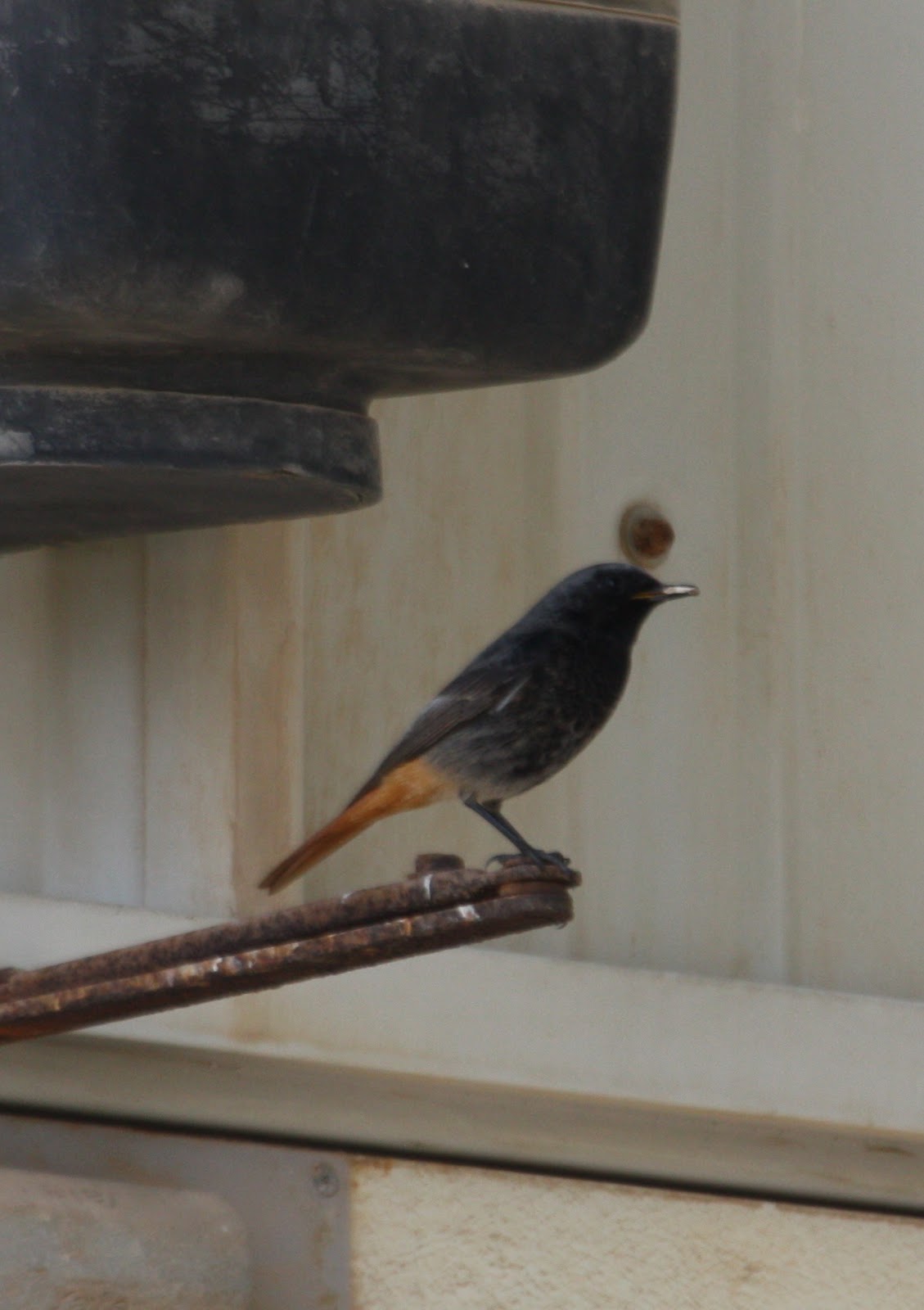
Khalifa had recently found a western race Black Redstart, which is quite possibly, the first for Arabia as well as a UAE first! At 1.30pm people started to arrive. Some arriving in more style than others!

Our Dubai birding cousins,
 showing us all how it is done!

There was quite a gaggle of us enjoying the bird, which performed on cue. Certainly, one of the biggest twitchers in the wild west. (Mark; Simon, Graham,Andrew Ward; Khalifa; Mike; Tommy & Maya).

A potential first for Arabia!
Nice finding Khalifa!


The more normal (in these parts)
 Eastern Black Redstart.
Photos courtesy of Khalifa.


Khalifa, one of a new generation of UAE
nationals who are interested in natural history.

Most of us then moved up the mountain, to see Mourning Wheatears which are regular winter visitors here.  These small fodder fields, atop Jebel Dhanna, provide a strong pull for tired migrants. We saw five individuals, a UAE tick for Andrew! (he is now one ahead of Simon, but who is counting)?

Mourning Wheatear, a regular winter visitor
to the extreme western parts of AD Emirate.
Photo courtesy of Khalifa.

This part of the mountain holds introduced Ural Sheep, an endangered Asiatic species. they are increasing and breeding well here. 

A fine male Ural Sheep.
Photo courtesy of Khalifa.

c300 animals are resident on Jebel Dhanna.
This is an important population
of this endangered species.
Photo courtesy of Khalifa.

The boys in action, stomping the fields.
Photo courtesy of Graham.

Our last port of call was the base of this isolated mountain. Khalifa had spottted a Eurasian Blackbird here a few weeks ago. So we went to check it out.  No blackbird, but at least 14 Eurasian Stone Curlews were in the area. A notable concentration and certainly my highest count together in the UAE. An excellent ending to a fine day out.

Eurasian Stone Curlew,
 which seem to be common in this area.


8 species added (total 137 species). 720 kms travelled.


Monday, 2 January 2012

The rest of mid- week

Finished work, on 2nd, a quick dash to the Hilton Hotel here in AD, for the only known colony of Golden backed Weavers. Construction work has surrounded the site and despite several nests seen, not a weaver in sight! Have to start looking elsewhere.

A scan through the fence at the Emirates Palace Hotel produced 2 Song Thrush + a plethora of common species. Arrived at the breakwater, where I usually seawatch from, to find I was approximately a kilometre inland from the sea! Reclamation again! Had to maneovre around, but scored with Socotra Cormorants; Caspian, Lesser crested & Saunder’s Little Terns. Not bad for winter.

Socotra Cormorant, an Arabian endemic.

A small pod of four Indo-Pacific Humbacked Dolphins
 were a welcome sight, just off the breakwater.

Western Lagoon was surprisingly productive with 31 Grey Herons & 13 Great White Egrets. Both high numbers for the island. 9 Caspian Terns were also noteworthy for the island. But the star, was a lone Eurasian Coot, swimming on the sea! A rare visitor to the island, it might be my first record.

Caspian Terns are regular in winter on AD island.

A young Heuglin's Gull. Lumped within the
 greater (pun) Lesser Black-backed Gull complex.

The view towards Mussafah Channel from the Officier’s Club was great, producing a wide range of estuarine species including 310 Greater Flamingo, a lone Sooty Gull and a welcome Great Black headed Gull among their commoner brethren. Best of the bunch was a Black-eared Kite feeding on a Black-headed Gull on a sandbank. A nice addition to the year list.

Great black-headed or Pallas's Gull

Black-eared Kite

24 species added (total 113) and 75 kms travelled.

It's the 3rd, and I have joined the commuting madness between AD & Dubai. My intention was to visit the Pivots, but after one & half hours on the road, I pulled off at Ghantoot. My main bird was of course, Grey Hypocolius. However, Ghantoot, is not the site it was a few years ago. Turning off the irrigation water has had a massive effect on the trees & they don't seem to fruit anymore, hence no Hypos!
A quick look through the wall of the Polo club produced 11 Pacific Golden Plovers & 4 Cream Coloured Coursers. Nice.

A great photo, courtesy of Shah. 

 On the way to the sea, on a relict patch of native vegetation, 6 Chestnut-bellied Sandgrouse gave excellent views.

Getting rarer along the coast in AD Emirate,
due to habitat loss.

The sea's gone! Yet again, another huge project, obliterating the natural coastline. No terns here then!
A quick look around the hotel grounds produced 2 Hoopoes & 2 Daurian Shrikes, but little else.

You can tell I live in AD, it took me
 three days to see one of these!

Time to walk the plantation, but quiet: 7 Desert Lesser Whitethroat & 4 Plain Leaf Warblers being the best. Plain Leaf's seem to have recently discovered these coastal plantations as a wintering ground, they are increasing in this habitat all the time. As dusk got a firmer hold a lone Song Thrush called, as it flew to roost.

Plain Leaf Warbler - a much sought after species,
 by visiting birders.


Ghantoot still holds a healthy population of
Southern Grey Shrikes in the plantation.


5 species added (total 118) and 210 kms travelled.

Wednesday the 4th, saw me wandering around my old haunt of Mushrif Palace Gardens. 3 Crested Honey Buzzards mobbed a passing Great Spotted Eagle & plenty of Alexandrine Parakeets were feeding in the tree tops.
Two of the three birds present.


A closer view of an immature Crested Honey Buzzard.

MPG's is one of the best places
to see Alexandrine Parakeet.

They all count as one on a year list!
2 Eastern Black Redstarts were in the back wood. The resident Eastern Olivaceous Warblers also put in an appearance. But, the bird of the afternoon was a Eastern Orphean Warbler on The Strip.


A walk around the racecourse produced very little, a pair of Common Kestrels performing well and a Glossy Ibis flyover was unusual here.

6 species added (total 124) and 70kms travelled.

A quick dash to Al Wathba Lake after work on 5th with my friend Robin, was quite productive. 57 species seen, best bird being Eastern Grey Lag Goose.

Robin, a new convert to birding?


The spectacle of 1,600 Greater Flamingos was impressive, especially when a Great Spotted Eagle started hunting them! Robin could be a recent convert to birding! With a name like that, he is half way there!

Eastern Grey-lag Goose,
a rare winter visitor to the UAE.

5 species added (total 129) and 30kms travelled.

The First day!

OK! It is now 2012! How do I know? Well, around 20,000+ people have just completed the countdown and told me so. One of them was Chris Martin! We have to trust him, don’t we? Coldplay were really superb and as I make my way home, I hope to see my first bird of 2012, but I dip on a Black winged Stilt, seen by everyone else in the car! I am not sure if it is a good omen or not!  It was time to hit the sack and get a little sleep, before my first, of what I hope to be, many big days.
The start of 2012, not a bird insight!
I spent the last day of 2011 with the family and just relaxing, doing very little. But, every so often, I would have a private sneak at the UAE bird list. How many would I see on Day 1? How many in the month? Which 2011 rarities would still be around for me to tick?
Waiting is always the worst part, and I was getting a little nervous, but excited, to get the year kick started at the same time.  I have planned my first week:
Sunday I am off to Al Wathba Lake with Neil, then drive to Al Ain, for the compost plant and Zakker Pools. Back via the Wathba fields at night, for Egyptian Nightjar and then home.  I am deliberately going to miss out the mountain and desert birds, concentrate on trying to get the rarities which were there until recently & could still be there now.
Monday try to collect Golden-backed Weaver in AD.
Tuesday, a flying trip to the Dubai Pivot Fields & Al Warsen Lakes, mainly to try for Sociable & Northern Lapwings, but also to collect a few other goodies for the notebook, like Purple Gallinule.
Wednesday afternoon at Al Wathba Lake, staying until dusk for the hirundine roost. I haven’t heard of any Pale Martins this winter so far, but who has been looking? Might sneak a rail or a crake as well.
Thursday afternoon around AD Island, Mushrif Palace Gardens for Crested Honey Buzzard & Eastern Olivaceous Warbler, then on to the western lagoon, for Caspian Tern etc.
Friday, all day with Khalifa and the boys at Jebel Dhanna, looking for the western race Black Redstart & Mourning Wheatear. Then on to Sila for hopefully, Redwing & European Robin among others.
Saturday all day around Dubai: Pivots; Ras Al Khor; Safa & Mushrif Parks. Lots of possible here, including a few rarities, like Long eared Owl! Could see 150+ species in the week???
That’s the plan; let’s see if it works out! It could be a hard week!
My trusty mode of transport for the quest!
 Courtesy of Nick Moran.


The UAE is one of the best locations
 to see Great Spotted Eagle in winter.

Feeding by EAD keeps numbers high at the lake.


Back to Day 1, I rose at around 9am & immediately kicked off the year list with a House Sparrow! Then I was on the road to Al Wathba Lake. The weather was fantastic and great visibility, meant birds quickly started to rack up. Out of the 44 species on offer, the best were a superb Great Spotted Eagle and the spectacle of 1600 Greater Flamingos flying away from the eagle, when it tried to hunt one of them! 85 Common Shelduck and 84 Pied Avocet were also noteworthy.
Then, back on the road, driving to Al Ain. The back of the Water Treatment Plant beckoned, but despite getting a few birds, including White-tailed Lapwing, nothing really stood out from the crowd. Dave Clark called, Eurasian Bittern showing at Zakker Pools! Five rally driving minutes later I was looking down Mark Smile’s telescope at the bird. And, what a bird it was! Mark and his wife Lou, had just spent three hours trying to find it & then I stroll up! Ermm! I then proceeded to get some sought after birds, thanks to more help from Dave. 4 Greater White-fronted Geese;  17 Ferruginous Duck; 16 Black crowned Night herons; 1 Spotted Redshank but best of all a Little Bittern standing just below the Big Bittern! Thanks guys, you were both great.
Eurasian Bittern, a cracking start to the year!
Thanks for the great photo Dave.
A quick drive to Al Quos  fodder fields proved to be an excellent move: adult male Pallid & Montague’s Harriers stole the limelight. A quick stamp around produced a good variety of pipits, including Blyth’s; Richard’s, Tawny; Water, Meadow & Red throated. A Eurasian Sparrowhawk caught a White-eared Bulbul right in front of my car, as I was leaving.

Blyth's Pipit, a tricky species to identify.
Call is definitive here.
A night drive on the new road across the desert was uneventful, then I arrived at Al Wathba Camel Racetrack  and right on cue, an Egyptian Nightjar performed  under the floodlights. A fitting end to an excellent, first day.
Egyptian Nightjar at Al Wathba Camel Racetrack.
89 species and 490 kms driven.