Oman is the huge, ancient country, rich in history, which borders the eastern boundary of the UAE. Population is sparse, distances are great and it is a wonderful country for wilderness camping & general exploration. The main factor which stops us going more often is the distance from Abu Dhabi. Over a two day weekend, it is a long trek; one spends as much time in the vehicle, as exploring the area. We tend to visit Oman, only if there is a long weekend, or an even longer holiday.
Carol was away in Australia visiting Tony & family, so I was alone & the Eid holiday was looming! Seven days off work, time enough for a quick trip! My friend Yousef had long wanted to visit Oman, so we made plans and set off mid morning from Abu Dhabi for a whistle-stop tour of the Dhofar region of southern Oman. Now, this area is around 1,300 kms. from Abu Dhabi, so it is a bit of a hike!
Yousef & I cleared customs with the minimum of fuss & we drove, straight into one of the most violent thunderstorms we have ever been in. It was immense! The wind was gale force, the rain came down in sheets, the sky was intermittently lit up with lightning and the sand blew hard, possibly the worst I have witnessed in twenty years in Arabia. We tried to press on, but eventually had to admit defeat. I couldn’t see anything! We pulled off the road & waited out the storm, the car was swaying violently & both of us exclaimed over the ultra-violent nature, on display in front of our eyes.


A couple of hours later, the storm eased & we continued somewhat gingerly, as the road was awash with a nice combination of water & sand. This slight delay meant we arrived at our camping site near midnight. I had camped here before, several times & I knew the area well. But this was a new experience for Yousef. It was his first night ever of camping! His mind raced, visions of wild, hungry animals filled his mind. All had one purpose, to devour a small, lonely Arab, who dared to camp in the desert! Despite his fears, tiredness eventually got the better of him & I heard the steady rhythm of his breathing, which heralded sleep.
We both woke early, dawn was breaking & both of us were eager to get to the waterhole, where we hoped, sandgrouse would be drinking. Montasar is a bit of a lonely outpost. Farming was attempted here in the distant past, but this was just a faraway memory now. Coils of barbed wire lay carelessly along the ground, testament to the forlorn hope of the people who endeavoured to make a living here. A few date palms somehow survived & a pump provides life giving water to his arid landscape. It is of course, good for birds and tracks of gazelle, proved that they are still hanging on here.

Waiting for sandgrouse. Judging by my expression, they hadn't arrived yet!

Little Stint, a long distance migrant on a pool,
in the middle of the desert!
 Barn Swallow - resting on the bare desert.
Muntasar is famous for sandgrouse drinking. They arrive in small groups, then larger flocks, early to mid morning, landing in turn close to the water, taking two or three quick sips before flying away. Not returning until the next day. The morning was dull & grey. The wind blew hard, no doubt the tail end of the previous day’s storm. We waited & waited. Eventually our patience paid off & we first heard the distant flocks, which gradually became a throng, before alighting right in front of us. We had chosen the location well and over the next hour, were related to some great views of Spotted Sandgrouse, the commonest species here. As we were leaving, a Golden Eagle flew down to drink, but was too far to photograph.

Muntasar is famous for sandgrouse drinking. They arrive in small groups, then larger flocks, early to mid morning, landing in turn close to the water, taking two or three quick sips before flying away. Not returning until the next day. The morning was dull & grey. The wind blew hard, no doubt the tail end of the previous day’s storm. We waited & waited. Eventually our patience paid off & we first heard the distant flocks, which gradually became a throng, before alighting right in front of us. We had chosen the location well and over the next hour, were related to some great views of Spotted Sandgrouse, the commonest species here. As we were leaving, a Golden Eagle flew down to drink, but was too far to photograph.


Spotted Sandgrouse

If you are patient, good, close views may be obtained.
We pushed on, further south. Qitbit is always a welcome stop on this lonely highway. But because it was still Ramadan timings, nothing was open. We contented ourselves with exploring the gardens, around the rest house. The only thing of interest, being a large flock of Brown necked Ravens feeding in the grounds. We yet again took to the highway.

Brown necked Raven at Qitbit.
If you have ever driven this lonely road, it is a bit like driving across the surface of the moon! Mile upon mile of featureless desert, with little or no signs of life. But, after what seems like an eternity, the arid landscape abruptly ends on the top of an escarpment. It is hard to describe, the scene which unfolds beneath you. It’s densely green, with patches of grassland, but even more astonishingly, there is thick forest down there!

The remarkable Dhofar escarpment.


A bit of a contrast from the stark, desert interior!

The monsoon winds bring cold moisture laden air, which embrace the coast, either as fog, or rain. Both provide perfect conditions for a host of flora to thrive. The contrast from the moon-like desert is so startling and unexpected, that even I, after many visits, am blown away by this landscape. It is one of the great hidden features of Arabia.

Arabian forest - a rare treat indeed!

The Crowne Plaza in Salalah our base for three nights

Yousef, photographing Dhor Swift,
which had crashed landed on our balcony!

Salalah is the second largest city in Oman & all roads lead to and from there in Dhofar province. It was our base for the next five nights. The town is rich in history; it originally gained prominence due to the frankincense that was extracted from the trees, which dot the escarpment. These perfumes are used for ritualistic purposes and are popular among the practitioners of Judaism. They are also believed to have some medicinal value. This valuable trade ensured the area was taken over by the powerful Sultanate of Oman in the nineteenth century. Indeed, for a time, Salalah was the capital of this powerful empire.

Frankincence tree.

A major trading route was established around this natural resource.
I love Salalah, it is the old Arabia, just like everyone imagines it. One can almost imagine Sinbad, the sailor walking along the beach! It is spreading & modernising, but it still has fascinating elements, that many other places have lost. It has a soul, which positively reeks of history, exploration & trade. All these elements mean the people are just as cosmopolitan. Omanis, Africans, Indians, Pakistanis, Bangladeshis & a smattering of Europeans make a cocktail, which seem to live in harmony. Life is laid back & slow, people have time for one another. Conversation is the national pastime and life is easy, compared to those inhabitants of the arid interior.

Spectacular seascapes

The sea pounds the coastline, it is very rich in fish & fish dishes are found everywhere along this coast. Abundant rainfall, means fruit trees & other crops can be grown, enough to trade with others to the north, who are less fortunate than these southern Omanis.

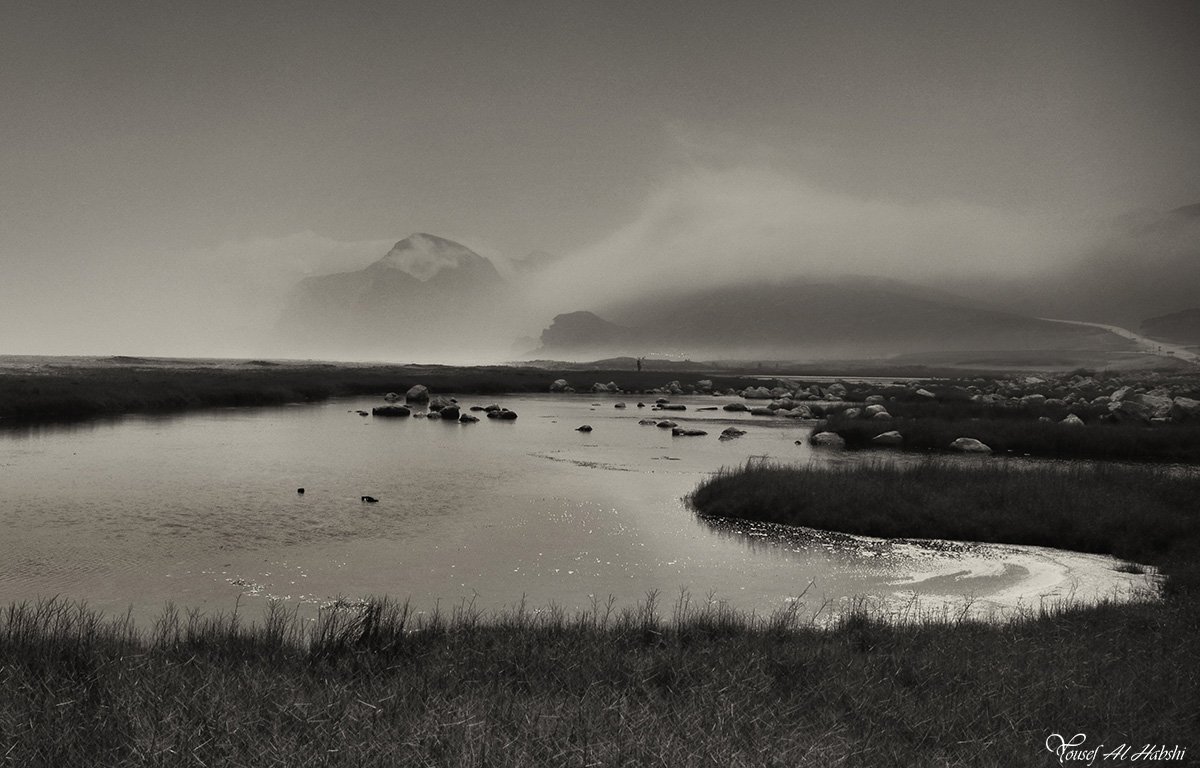
Fog-laden seas, are a daily feature along this coastline.
 Sooty Gull - a common inhabitant of this coast.

Did I mention the unique natural history? Did I tell you about the endemic birds? The great variety of plants and even large mammals to be found here. Yousef & I had five days to explore both east & west, it was time to move.

Time to go exploring!


Our first stop was Ayn Hamran. The forest is thick here at the base of the escarpment. There is a natural spring & a fallaj (irrigation system), which is attractive to birds. In the summer time the entire area echoes with the calls of Didric Cuckoo & Grey headed Kingfishers. Both summer breeding migrants from mainland Africa. These forests & hills being their only breeding location in Arabia. Yousef spent a lot of time photographing the macro world, while I wandered further afield, in search of birds.

Typical habitat for most of the Dhofar endemic birds.
 Notice the river flowing! A rare event in Arabia!


Grey-headed Kingfisher, calling & displaying.
 A very common species in all the forested valleys.


Paradise-Flycacher - a spectacular visitor.
The taxonomy of this species, has been in debate,
but now thought to be African Paradise-Flycacher.
We quickly established a routine, up early at dawn. Drive to a promising location along the base of the escarpment. Lunch on the hoof, drive to a second location & back to Salalah for the night. During the next few days we visited all of the best spots, including the incredibly beautiful Wadi Darbat, which was half flooded with water & people hell bent on enjoying the recent rains! This area deserves more attention, as it holds large animals such as Caracal, but as ever, this species eluded us.

Looking into Wadi Darbat

Wadi Darbat is one of the largest wadis
along the escarpment.

Blackstart - a common escarpment species,
found in a wide range of habitats.
The coastline is equally dramatic. Foggy headlands jutting spectacularly out to sea & forming excellent vantage points for viewing seabirds like Jouanin’s Petrel, which were common. On some days, over 200 were recorded from a quick sea watch. If one travels west towards Yemen, the coastline is breath-taking: blowholes & dramatic sea & cliff vistas, dominate this arid landscape. Every turn of the road warrants a stop & invites exploration.

Great sea-watching is possible off headlands such as these.

Jouanin's Petrel - a star performer!

Another star performer! Yousef, in action!

Stark, spectacular coastline scenery,
close to the Yemen border.

Cinnamon breasted Bunting is a common species
on the escarpment & in the grasslands & forests.
A compulsory stop is Khor Rori (Rawri), a small fortified town. It was an outpost for the Kingdom of Hadramawt (Yemen). One of the Queen of Sheba’s palaces was located here. Inscriptions at Khor Rori indicate that the town called Sumhuran was founded here, probably to control the purchase & trade in frankincense. Khor Rori is almost certainly the exporting port of Mocha Limen mentioned in the first century by Periplus Maris Erythraei. Recent excavations have indicated the importance of this site, which had trading links with India, Hadrami homeland and even the Mediterranean region.

A superb natural harbour, for both man & birdlife.
 One of the most important, ancient sites in Dhofar.


Khor Rori - an important archeological site in Dhofar.
It is in a spectacular setting, raised on a small headland with large freshwater khor below, providing both abundant freshwater fish & a safe harbour for vessels, which plied their trade along this dangerous coast. It is also good for both desert & water birds, which sometimes may be seen side by side.

It is in a spectacular setting, raised on a small headland with large freshwater khor below, providing both abundant freshwater fish & a safe harbour for vessels, which plied their trade along this dangerous coast. It is also good for both desert & water birds, which sometimes may be seen side by side.


A close up of the dense vegetation.
The days were action packed & filled with great sightings, but all good things come to an end & we had to retrace our steps along the lonely highway & thirteen hours later were arrived home, tired but pleased with the week. Both Yousef & I were keen to go back for more.
A big thanks to Yousef for keeping me company & allowing me to use some of his stunning photographs.
A big thanks to Yousef for keeping me company & allowing me to use some of his stunning photographs.
Till the next time.


