Saturday, 30 June 2012

Wanderings in Wadi Tarabat

It is a lovely summers day here in Abu Dhabi! I am not joking! For some unknown reason, the temperatures are a balmy 37 degrees Celsius & not the unbearble 44+, which is the norm. Dawn is breaking & I am in Wadi Tarabat, which is a major wadi, flanking Jebel Hafeet, in Al Ain. I prepare for my hike, I plan to walk the entire wadi! I am searching for Trumpeter Finch and Short-toed Eagle, both needed for my year list. Wadi Tarabat is a good place for the former species and an outside chance for the latter.

Wadi Tarabat.

 
It is one of those glorious days which we get so rarely here, no humidity- yet! I feel good and start hiking. It is a pleasure to be out and about. A pair of Bonelli’s Eagle launch themselves off the cliff,  high above my head. They breed here, but I can't quite see the nesting site. 2 Upcher’s Warblers dance around in the bushes. Late migrants? Or potential breeders? This is exactly the type of habitat for them to breed, but so far, no confirmed breeding records for the UAE.
I continue my search, I kick a pair of Sand Partridge off a nearby ridge, they noisely whirr away. All the normal species are calling- Hume’s Wheatear, Desert Larks etc. But nothing like a Trumpeter. I continue up the valley slowly getting higher. I spot a water seepage coming out of the mountain high above. 300+ Rock Doves are bathing and drinking in the early morning light. I stake out the water, but to no avail.

Water, is in short supply
in these mountains.
I hear hooves on the sheer cliff, but I can’t see the culprits - Arabian Tahr! Livestock were removed fom this area over a decade ago. I scan feverishly, but without success.
Slowly I hike back to the car, the heat is starting to build now. My next stop is the back wadi in Green Mubazzarah. At the end of this wadi is a small area of water. This is my back up plan for the Trumpeter. I have seen them here in previous years. Despite my long wait, nothing arrives to drink.

Plan C involves driving to the top of the mountain. 24 Egyptian Vultures are circling around including some birds of the year. A adult Barbary Falcon briefly joins them on the ever rising thermal. That is my best count of vultures for a long time. Jebel Hafeet is their last remaing stronghold in the UAE. Elsewhere, it is a rare bird these days.

Egyptian Vulture
A variety of birds, of different ages were seen.
Several recently fledged birds were seen.
There is no evidence of breeding within the UAE.
All birds coming from the mountains of Oman.

I find a leaking water bowser, I yet again begin my wait. Nothing but a thirsty Desert Lark comes to drink!

Desert Lark.

A common inhabitant of these mountains.

 
I drive down the mountain to my last port of call – Zakher Pools. The pools are shrinking slightly, but they are still vast! 9 Grey and 2 Purple Herons are along the shoreline. A lone Spoonbill sleeps away, in the heat of the morning. A Black-crowned Night Heron utters a croak from within a tree. Soon I see why. A Purple Heron has landed in the same tree and is actively hunting House Sparrows which are nesting there! I have never seen this kind of behaviour before!
14 Eurasian Coot are out in the middle of the lake, some attending nests. A good breeding record for the country. Over 35 Little Grebes are trilling away the day, some with young.
I drive home, reflecting on the day. It had been surprisingly productive, some good species noted, but unfortunately not my target species. I pull up in the driveway just as Carol & the girls arrive. I am informed that I smell! A quick shower and then a dip in the pool with a beer, knocks me out and I sleep for an hour. I awake, it must be time for my second beer!

0 species added (293 species in total): 360kms travelled.

A splash of summer madness!

Yes, it has been a long time since my last blog. However, there is a reason for this! I was away for nearly four weeks, on a journey that takes one across the roof of the world. A great trip, see forthcoming blogs.

It is Thursday and it has been a long week, since I touched down on Abu Dhabi soil from Chengdu. I can get off work early today, so I am hammering over to the east coast. I arrive to meet up with Khalifa & Abdullah and we are off on my first ever fishing trip! We go quickly out to sea, to an old ammunition dumping ground, that Abdullah reckons will have fish and therefore birds!

The fishing route is marked in red.
 Previous important records also marked.


Luckily, the explosives are
six hundred metres below!

Both maps courtesy of Khalifah.

We see nothing at all on the ride out. Scanning the horizon produces our first flocks of Bridled Terns and they are fishing!
Bridled Tern

We motor over and see tuna churning the surface. For the next five hours we go from one shoal of tuna to another, always with hungry birds in attendance.


Plenty of small fishing boats from both Oman
 & the UAE were catching lots of tuna.

When Tuna are feeding the water is in turmoil!


Tuna fishing Arabic style seems to have no rules, it is a glorious mayhem of dashing boats, pushing their way in, to gain the best spot. We start to catch fish, the lines with wicked hooks fly over quick and fast. Definitely one eye on the sea and the other on where those hooks are going!

Around 150+ Persian Sherwaters were noted.
We log around 800 Bridled Terns and scattered around in small groups are Persian Shearwaters, probably around 150, all told.

Flesh-footed Shearwater


A dark, black shape wheels around, our first Flesh-footed Shearwater. They were to be our intemittant companions for the rest of the day. At least 12 noted, but could have been many more. It is difficult to count birds when you are fishing, too much to keep an eye on, happening elsewhere!

I spot 2 Fleshies sailing by, with a slightly smaller, thinner winged bird, bringing up the rear. I shout to Khalifah, Wedge-tailed Shearwater! He sees it going away, as it doesn’t linger.

Heavily cropped and not sharp.
However, it does show the shape and flight quite well.

Wedge-tailed Shearwater
You can see several good features here:
 the size, colour & shape of the bill;
the wing & tail shape and the pale secondary bar,
which is a good pointer for this species.

 At least 6 Wilson’s Storm Petrels flutter over the waves, my first of the year.

The catch!
Tuna photos courtesy of Khalifa.
The fishing was productive, as was the birding. It was a lot of fun! We motor back in the dark and dock at 8.45pm. I have a long lonely drive ahead of me!

Three year ticks, get my big year, back on track!

3 species added (293 species in total): 550 kms travelled by car & 130 kms by boat!

Sunday, 27 May 2012

The fading Spring!

On Thursday 24th, I drove north from Mender to Al Quoa Fodder Fields. It was very quiet: 5 European Rollers & 3 Marsh Warblers being the only migrants present. Several pairs of Red wattled Lapwings were breeding, as were at least 50+ pairs of Crested Larks.


European Roller

At least four pairs of Red wattled Lapwing
had nested & had young.


 I then drove to Al Ain and met up with Huw. He was kind enough to once again drop what he was doing & gain me entrance into the Al Ain Water Treatment Plant. The White-rumped Sandpiper was again on show, together with a Terek Sandpiper & 3 Little Stints. A good inland record was of a fine full summer plumage Lesser Sand Plover, no doubt on its way to the Tibetan Plateau, which is of course my next port of call as well!

We had a quick look at Zahker Pools: Spoonbill; Purple Heron; Little Bittern and a Ferruginous Duck all still hanging around. The 14 Eurasian Coot could well be breeding.

0 species added (290 species total): 650 kms travelled.

After the Thursday evenings festivities, Carol & I enjoyed a leisurely breakfast & briefly visited Safa Park in the middle of the day, on Friday. An adult Shikra was nice, & a lone Upcher's Warbler was the only migrant I could find.

Upcher's Warbler has a long spring migration
 through the UAE.

 
0 species added (290 species total): 160 kms travelled.

Sunday 27th, saw me birding the MPG's in the vain hope of adding to my stagnent year list! As expected, it was very quiet: 11 Marsh Warblers & a Common Nightingale were the only migrants present. The four pairs of Eastern Olivaceous Warblers were much in evidence. This is still the only known breeding spot in the whole of Arabia! Which is quite remarkable!

0 species added (290 species total): 80 kms travelled.

Saturday, 26 May 2012

A farewell to Andrew!

A group of UAE birders met up in the Stables Bar in Dubai last Thursday evening (24th May).The occasion was Andrew's leaving party.  Andrew, will very shortly be leaving us after 19 years in the UAE.
 I met Andrew in September 1993, when he moved into the apartment that I was vacating here in Abu Dhabi. He quickly got into his birding stride & was a frequent member of the group that birded Al Wathba Fields for over a decade. He was also a very keen birder on Abu Dhabi Island and we all enjoyed his company on many really good birding days.

Andrew, notice the empty glass!
Nora & Carol.
Simon & Grace
Andrew, one pint later!
Me & the boy!
Another pint later! Andrew trying to
 master modern technology!
A few years ago, he moved first to Sharjah & then Dubai, with his job working for the Higher Colleges of Technology, so I saw a little less of him. But he continued to be a passinoate birder in his new surroundings and was a regular visitor to the Dubai Pivot Fields and more recently Mamzar Park.
Andrew, with his famous white socks!

 
We had quite a lot in common apart from our love of birds & birding. Andrew had lived in Zambia for 14 years and married a local girl. They still have a house & farm there. He also has a small house in Southhampton and another residence on the Isle Of Wight which is rented out.
A slightly more unusual residence of his, is his railway carriage on the beach on the Isle Of Wight! It is strategically positioned to keep an eye on a small Little Tern colony. I am sure he will divide his time between all these places now he has the time to do as he pleases. I know he is particularly looking forward to birding this autumn in England. Something which he has never done, as for many years he has been overseas.

We wish him all the very best in his twilight years and look forward to birding with him again in both Zambia & the UK.

On the edge of the Empty Quarter!

The Empty Quarter is a vast area of desert, which is mainly in Saudi Arabia & just straddles over into the territory of the UAE. It is a huge area of desert wilderness, with hardly any human habitation. However oil is under the surface and that is why I was there, conducting an environmental baseline survey, before exploration proceeds. I was based in Qasawira Camp, but most of my travels were in the Mender Concession.

The land of the mega-dunes.
Stunning desert scenery.

Large, flat sabkha plains are found
inbetween the high dune fields.

The main highway to Qasawira Camp!

We try to make people as environmentally aware
as possible. Here, written in three languages!
Saltbush vegetation is often found
at the base of the large dunes,
 where underground water collects.


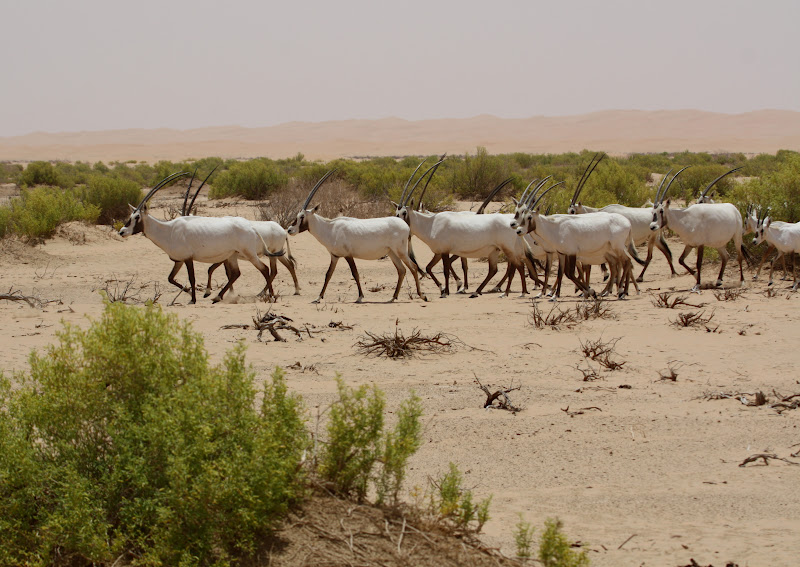
It is big dune & big sky country & is fantastic for just exploring. My three days down there, were not that productive, mainly because of the time of year, but it was nice to just drive & walk around. It is this area that has been chosen as a release site for the critically endangered Arabian Oryx and the endangered Sand Gazelle. Both are now firmly introduced into this region and seem to be thriving. Young are now been born in the wild & the animals are wandering ever more widely, as the programmes progresses and it has been very successful.
A herd of Arabian Oryx, at home,
in their natural habitat.
A satellite tagged animal in a holding pen,
ready for release.
In the early 1970's
this species was on the very edge of extinction!
This particular herd roam extensively
 over this huge area.
A wonderful UAE conservation success story!
The critically endangered Sand Gazelle.
Animals are fed & then slowly encouraged to wander
 further afield & forage for themselves.


The vast expanses of the Empty Quarter pose a huge barrier to bird migration. Many birds must perish each season. Any shade is used, so this grove of trees was very attractive, holding 35 Marsh Warblers!

Shade & water is at a premium here!

Marsh Warbler.

A Marsh Warbler looking for water.
Where trees have been palnted European Turtle Doves have moved in to breed. There are literally hundreds of pairs of this species in the deep southern deserts.
European Turtle Dove is a common
 breeding summer migrant here.
Brown necked Raven has its stronghold here,
in these vast deserts.
Over three days: 290 species (0 species added): 630 kms travelled.

A young male, Sand Gazelle.

A young Sand Gazelle.
Resting in shade, during the heat of the day.